By the Lineo Team
As I write this, Lineo is less than a year old. In human time, it's just starting to take baby steps. In Internet time, it's been around since the early Pleistocene. In Linux Time, it's nearly Jurassic — having been formed even before the Red Hat IPO.
If we look at the rest of Lineo's branch on the Linux evolutionary tree, the company dates from the Cambrian, having begun as part of Caldera. The company, formerly Caldera Thin Clients, makes the Embedix operating system and related development tools for embedded systems. Based on sister company Caldera Systems' OpenLinux platform, Embedix controls the embedded microprocessors found in set-top boxes, handheld devices, and other items with dedicated purposes . Other products include Embrowser, an embedded Web browser based on a derivative of Microsoft's DOS. Clients include Sun Microsystems (one-fourth of sales), Brooktrout, and Symbol Technologies. Investment company The Canopy Group, led by former Novell CEO Ray Noorda and Lineo director Ralph Yarro, and Caldera Systems collectively own nearly 60% of Lineo.
Kim Clark, VP Engineering
David Reeves, Director Partner Marketing
Lyle Ball, VP Marketing Communications
We have a Linux to all of those platforms. Some of which are very small microcontrollers that don’t have full featured CPU sets, they don’t have an MMU (Memory Management Unit) for instance. So we have to modify Linux sufficiently to run on very small devices. But we also do very large devices. With Linux, we can actually cover a broader depth of platforms than the real time OS vendors.
We are doing a far amount of high end devices such as telecomm switches and voice over IP components. We are doing very high end Internet routers and even Internet caching servers and such. These are single function boxes on the high end. But on the low end, our value add is not only making sure that we port Linux, but we provide the tool set so that you can target one of these devices either from a Linux box or from an NT box. So that the developer can cross compile, remote debug and configure the features that they want on the device.
We also work with third-party software vendors—Jabber is one of them—to make sure that their applications are available to the device vendor for inclusion on the embedded devices.
Craig’s note: the embedded OS is referred to as RTOS or real-time OS. Brian claims that the second tier RTOS vendors are using a bait and switch tactic with Linux as an RTOS. They tell the device manufacturer they can do Linux and then try and switch them to their own platform.
We are in the tools business and in the Linux porting business. We are not in the compiler business we use the GNU compilers because that’s what Linux uses. But we do wrap the GNU compiler. We have to do a fair amount of work to make sure that we pre configure cross compilers for Power PC targets or Hitachi targets or whatever. And then we have our own tools that we built on top of that.
We do a fair amount of library (Linux library) manipulation on the target to reduce size and execute in place out of ROM and hard real time extensions and all kinds of things.
Craig’s note: The aforementioned tools for NT is an unannounced matter. I mentioned it again in the conversation. What that means is that right now, his RTOS development tools only run on Linux but Lineo is in the process of porting those tools to NT.
Craig on IM on RTOS: It doesn’t make sense to have a store-and-forward messaging service because the device may or may not have any storage. Plus, the device usually isn’t suited to stop what it is doing and read its own e-mail.
This is why an Instant messaging service makes sense because what I want to be able to do is know if the device user is online and if so, be able to establish a connection and exchange real time data.
Brian: That was well said. That struck me. That resonated with the reason for instant messaging the way you just said that. I hadn’t thought of it that way. Maybe this is why our ISV guy is so excited. He has never articulated to me why he thought this was such a good idea.
Craig: I am not sure that the way Jabber provides instant messaging services would work for you because since it is XML, you will need to have an XML parser.
They sell tools for customizing the OS to embedded purposes. The app might be infrared or serial connection or a microwave. Each operates differently and therefore needs a different os. How do you build, test, debug and update that. The embedded linux business is providing the tools for doing that. A phone swith needs api, services and subsets.
Brain: Fortunately for us, we own one.
Ransom: The OS platform of the future will be based on open access/open source. Thin device proliferation will be in the millions. A sister company of ours does satellite routers based on open linux. Add wireless to that — something with BlueTooth-type functionality, and you have significantly extended he internet's infrastructure.
From Talk with Lyle ball
www.mp3factorydirect.com/pjbfeat.htm
SDK
It's about time to market, size (to reduce hardware costs)
The first thing you need to understand is what are all the packages? Which ones do I need and which ones don't I need? What ae the dependencies associated with each of the packages?Choosing one package may require choosing two or three other packages. But they also might conflict with packages from another module. So you have this hairy and complicated task of figuring out all the things that need to be there. So we have built a tool to figure all that out in a gui environment.
small as possible to fit in the smallest footprint. We have apice called LIPO, which goes in and sucks out all the fat. The shared libraries are big and fat. If yuou have several modules sharing libraries, each with a copy of that library, you;ve got a bigger footprint. We cut fat out of that. We also reduce the size of each libraries' footprint. We also go in and reduce stuff that will never be called or used. So you have a footprint that fits each embedded device. All the functionality .
Any developer can do this himself, but why?
We do the same for apache. By cutting out icon support, you save 22k of memory. We take apache, cut it into microcomponents, giving developers the choice of using only the parts they need.
We don't have a preferred web server, just a popular one with apache.
The exciting thing about messaging is what happens when devices talk to devices. Xml works like a backbone. What XML does is allow you to dynamically determine the content passing back and forth. HML has a rigid structure. XML allowsthe content to explain itself, and say "this tag is an address," and "this tag is a setting." The application just accepts it. There is nearly infinite flexibility around using and storing data. It's a fluid system. Tag definitions are infinitely flexible.
If I have a device like a stereo system and I want it to be able to com unicate with an internet device that;'s pulling down information, like music vrom the internet. My stereo can now communcate with that internet server in a way that they both speak the own language. The applicancce or server may not care about the data, but will care about the tag. The two can agree that a given tag identifies the name of a song.
Andre says you've got a device driving framework for all of reality when you combine instant messaging, XML and programmability from linux laying in all these devices.
You've got all these intelligent devices in your home. You're on vacatoin and you want to turn on yuour sprinkler system, you can do that with your pager, sending the right tags to the sprinkling system. You'll have tags for start time, duration, whatever.
Why hasn't this happened before? Is it that the embeddeed world is a proprietary feudal system, where guys like Echelon come along and try to push the home automation rock up a hill by making the perfect chip that gets embeddeed in everything, while the market is in fact a bunch of noncommunicating niches that are hardly even aware of each other — home audio, lawn sprinkers, security, phone systems, TV satellite, HVAC, home appliances... This has been a holy grail for a very long time. We've read Home of the Future fantasies in newspapers and science magazines since Jules Verne and it hasn't happened. And I never thought it was going to happen... until this wave of embedded Linux adoption, which threatens to provide an OS universality that wasn't there before. You had these incompatible and/or noncommunicating operating systems, chips and other pieces.
Lyle? The industry is discovering that they now have usefull intelligence to build into their devices. It allows them to sell, amange or maintain whatever they've got. They can do remote diagnotstics. The appliance can report its status or its troubles back to the manufacturer, the seller, or the user in the home. The refrigerator maker has a motivation in preventing lawsuits over, say, food spoilage. So we find there is a lot of demand out there, by the manufacturers, for building intelligence into their devices, but nobody providing the universal context for conversation among these devices, or between them and any interested party. But when yuou add XML , with its infinite flexibility, and an instant messaging framework like Jabber's, and you've got that universal context. It suddenly makes it very attractive to manufacturers to install intelligence — Linux intelligence, of course — because it has a useful context. It's not just a bell & whistle issue any more.
DS: Do you agree with Craig Burton that XML is the most significant idea since calculus — because it allows us once again do determine the dynanic relationships between things?
? Yes.
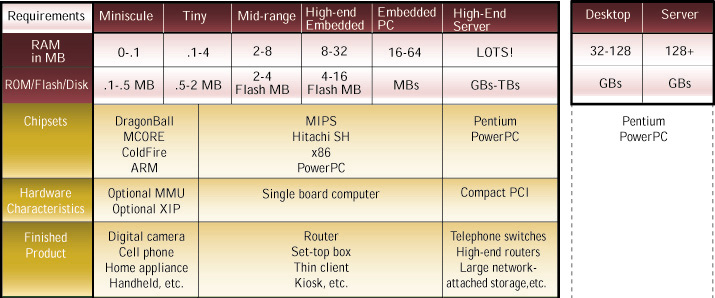
This is the Lineo view of the world. But it could be anybody's. None of the lines here are definitive, which is why we use the shading in each box. We just want to give an idea of scale, and to plot categories against RAM, ROM, chipsets, types of hardware, and the kinds of finished products that would use these combinations. We have solutions for each of these, of course. The important thing is that, while the desktop and server areas are familiar territory, the rest of the world — the embedded device world — is not. There is a lot of existing expretise everywhere on this chart, but when you get down to the finished product level, that's where you've got the feudal system that Linux and these other developments begin to eliminate.
DS: Where would a Palm go?
Mid-range. High end.
? We're talking about required space and memory for the OS and its associated applications to run in.
DS: So the device size in a third dimension here.
David Rieves? People are going to have to think differently here — even people already in the embedded space. on the one hand we see the glories of eight and sixteen bit systems, because in the past that was the size needed for the required functionality of the modern device, and cheap enough to build in without driving up cost too much. Now 32-bit hardware is cheap, and commodity stuff. So you hold overhead down in the OS, which is why Linux is so appealing. The timing is right. Or ripe. The hardware costs are down, interest in Linux is up. There is this huge interest in Internet appliances. All while Linux has such core technical strengths, even outside speed and cost of deployment, local language and local time zone support and all these other inherent advantages. The technology alone leads to creation of internet-savvy devices.
DS: I imagine some of the trouble Microsoft has in the embeddeed world is dragging CE in from the right.
Lyle: absolutely. They're cramming Windows down into